Reward's biggest blind spot and the new data that proves it

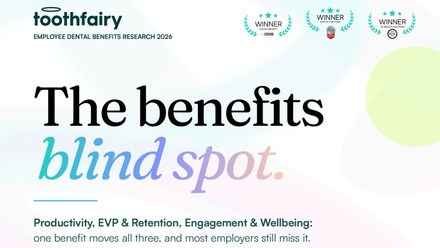
Research from Toothfairy and YouGov shows the benefit being overlooked in most reward strategies is quietly undermining the three things employers say they care about most in 2026; productivity (30.6%), EVP (21.3%), and wellbeing (18.4%).
Dental care touches all three at once. Yet 45% of UK employers offer no dental provision at all, rising to 65% among small businesses and persisting in nearly a quarter of large organisations.
A crisis employers can't see
Only 38% of employers track unplanned absence by specific cause, meaning dental-related absence is effectively invisible to roughly six in ten organisations. They feel the operational cost of people being away. 92% believe dental-related absence negatively impacts business operations, but they can't attribute it, cost it, or build a business case to fix it.
That blind spot compounds a genuine access crisis. With about 90% of NHS practices no longer accepting new adult patients, 73% of employees now delay dental treatment altogether, and costs can climb up to 13 times higher once problems are left untreated.
Employers largely know they're exposed: 57.9% aren't confident their people could access a dentist within 48 hours if they needed one today, and fewer than one in five describe themselves as "very confident."
Where existing dental benefits fall short
Where dental provision does exist, it's rarely a deliberate strategy. It typically sits within private medical insurance as a lighter-touch dental add-on, offering more limited reimbursement than a standalone dental plan. 19.4% of employers offer dental through this mechanism, rising to 34.1% among large firms.
Cash plans are the next most frequent offering, with 15% offering an employee-funded cash plan that relies on employees funding this directly. In reality, only 13% of employers offer a genuinely company-funded dental benefit.
The result is a significant gap in protection. Three in four employers offering dental benefits report challenges with the current landscape, with 39% citing rising costs as a key barrier. Many existing benefits still require employees to fund much of their own dental care - at a time when the cost of dentistry is increasing and access to NHS provision remains constrained.
This creates a growing need to shift the focus towards prevention and earlier intervention as a cost control measure, as well as an employee healthcare one.
In a recent survey of more than 1,500 Toothfairy members, 8 in 10 believed tools prioritising access and early intervention could help them identify and prevent dental problems earlier, while giving them greater confidence in managing their oral health. The knock-on effect for employers is absence prevention, positive productivity outcomes, and a winning EVP:
The EVP case hiding in plain sight
For an EVP that's supposed to attract and retain talent, the opportunity is stark. 79% of employees say they would take up a dental benefit if their employer offered one, one of the highest take-up rates of any workplace benefit.
Everyone needs routine dental care each year. When access is constrained, problems go undiagnosed, engagement drops, and the productivity and wellbeing costs stack up quietly in the background. Already, 48% of employees have left work early or taken time off specifically because of dental issues, part of an estimated 23 million UK working days lost to dental problems annually.
One case study with Operose Health, the UK’s largest primary care provider, shows the scale of the blind spot. In a survey it uncovered a chronic, previously unspoken dental access problem within its 1,800-strong workforce, worth an estimated £400,000-plus in annual absence cost alone. A prevention-first intervention built around that finding delivered a £284,000 net ROI within four weeks.
Closing the gap
The strategic case here isn't that dental is a nice-to-have. It's that an unmanaged dental gap is already quietly undermining the outcomes HR is prioritising (and judged on), and that a modern dental benefit can convert that liability into a measurable advantage, provided it's built around genuine fast access, visible usage data, and low administrative overhead rather than legacy mechanics.
The full findings, including the breakdown by company size, the real reasons employers give for offering no dental cover at all, and the five tests a modern dental benefit needs to pass, are available in Toothfairy and YouGov's new report, The Benefits Blind Spot.
Supplied by REBA Associate Member, Toothfairy
The world’s first on-demand dental benefit. Save time, cut costs, protect employees.