Workplace neurodiversity: Helping employees with ADHD
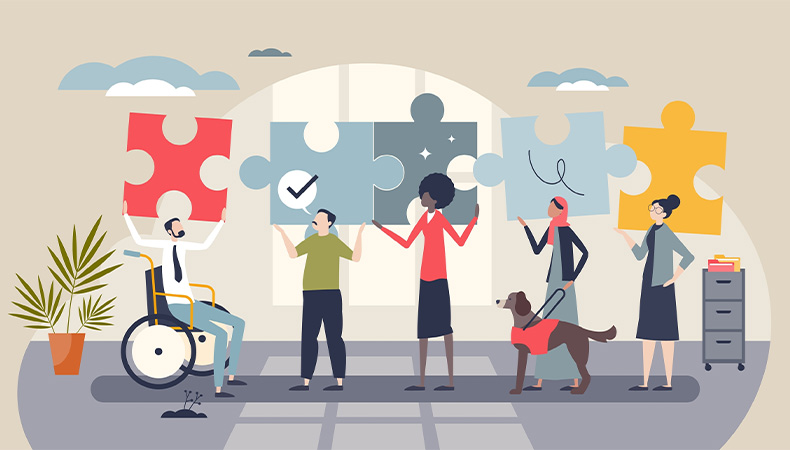
Workplace neurodiversity support helps employees with ADHD thrive by pairing clinician-led guidance with practical accommodations.
This can include flexible focus time, adapted communication styles, and coaching on organisation and time management, so people can work with their brain instead of against it.
Handled properly, it turns a condition that's often misunderstood into a genuine source of strength, including sharper problem-solving, high energy under pressure, and creative thinking that a standard 9-5 structure can otherwise suppress.
More common than most strategies assume
Estimates put adult ADHD prevalence in the UK at between 3% and 4% of the working-age population. NHS diagnosis waiting lists mean many adults spend years managing symptoms before they get a formal assessment, if they ever do.
On a mid-sized workforce of a few thousand people, that's a meaningful segment of your talent.
The pattern HR leaders tend to see isn't poor performance. It's inconsistency: strong strategic thinking paired with missed deadlines, good client relationships paired with a chaotic inbox, real creative range paired with difficulty starting low-interest tasks.
Without the right support, that inconsistency gets read as a reliability problem. With it, it's simply how a different kind of brain gets to its best work.
Employers already have a legal duty
Under the Equality Act 2010, employers have a duty to make reasonable adjustments for employees whose condition amounts to a disability, and ADHD very often qualifies.
As Acas explains, an employee doesn't need a formal diagnosis to be covered, and they're not obligated to prove their condition with medical evidence before an employer offers support. Given how long NHS ADHD assessments can take, that distinction matters: waiting for a diagnosis before acting on adjustments leaves people unsupported for months or years.
This is where a lot of well-intentioned policies fall down. A generic "neurodiversity statement" in the employee handbook isn't a reasonable adjustment. What the law, and employees, actually need is a way to ask for support, a manager who knows how to respond, and adjustments that are reviewed and actually implemented.
Gap between saying and being inclusive
Deloitte's 2024 Disability Inclusion@Work survey is a useful reality check for anyone who thinks their existing benefits already cover this. Among employees who had disclosed a disability, chronic condition, or neurodivergence and gone on to request a workplace accommodation, nearly three-quarters had at least one request turned down.
Only around a quarter of people who'd disclosed had asked for an accommodation at all, which suggests the barrier often isn't awareness. It's trust that asking will actually lead somewhere.
That's the gap workplace neurodiversity support is meant to close. It's not another wellbeing perk sitting alongside an EAP that nobody uses for this. It's a specific, clinician-informed pathway that gives employees somewhere to go before things become a performance issue, and gives managers a way to respond that doesn't rely on guesswork.
What good neurodiversity support should include
The strongest programmes combine three things, and most fall over when they only do one.
- Clinician-led guidance for the employee. One-to-one sessions with a specialist or ADHD coach who can help someone build systems that suit how they work, and strategies tailored to inattentive, hyperactive, or combined-type ADHD. Peppy's Neurodiversity service gives employees direct access to this kind of specialist support, recognising that neurodivergent employees often need support that sits outside a standard EAP's remit.
- Manager training that goes beyond awareness. Line managers are usually the first point of contact when an employee is struggling, and an hour-long unconscious bias session doesn't equip them to have that conversation. They need to know what a reasonable adjustment conversation actually sounds like, how to avoid putting an employee on the spot, and what to do when someone asks for support without a diagnosis in hand.
- Practical, individualised accommodations. Acas's guidance groups these usefully around the areas ADHD most commonly affects at work:
- Concentration: noise-cancelling headphones, a standing desk, protected focus blocks, permission to work somewhere quieter than an open-plan office.
- Organisation and time management: visual planners, regular short check-ins rather than infrequent long ones, breaking large projects into smaller tracked tasks.
- Written communication: instructions broken into clear steps, extra time to process documents, the option to talk through feedback rather than receive it only in writing.
None of these are expensive. Most cost nothing beyond a manager's time and a willingness to ask what would actually help, rather than assuming.
Retention, absence and the cost of not adjusting
The business case is straightforward.
Acas notes that neurodivergent employees are more likely to experience burnout, which drives absence and turnover, both of which are far more expensive than the adjustments that prevent them. A colour-coded planner and a standing desk cost a fraction of recruiting and onboarding a replacement, let alone the lost institutional knowledge when a strong performer leaves because they were quietly struggling and no one asked why.
There's a reputational dimension too. Candidates increasingly ask about neuroinclusion during interviews, and employer-review sites make it easy to see which companies deliver on their DEI claims versus which ones just publish a statement. Specialist, clinician-led support is a differentiator that's hard for competitors to fake with a policy PDF.
Getting started as an employer
- Audit what happens when someone asks for support today. Is there a clear process, or does it depend entirely on which manager they happen to have?
- Give managers a script. A short, practical guide to reasonable adjustment conversations does more than a one-off awareness session.
- Bring in specialist support rather than stretching your EAP to cover it. General mental health support and ADHD-specific coaching are different disciplines, and treating them as interchangeable is usually where good intentions stall out.
More about Peppy’s Neurodiversity support.
Supplied by REBA Associate Member, Peppy
Peppy is a global app-based employee benefit giving employees access to expert clinical care in menopause, fertility, pregnancy, and more - trusted by 250+ companies and reaching over 3 million people.