How integrated healthcare can elevate early interventions

Screening, education and early detection have limited strategic value if employees do not have a clear route into appropriate clinical or occupational support.
Prevention has become an increasingly important part of the workplace health agenda. According to REBA’s Health and Wellbeing Research 2026 report, 48% of employees currently use wellbeing or prevention programmes sponsored by their employers, with an additional 36% planning to do so in the next two years.
But prevention is only the first step. UK employers looking for a proactive method to address the estimated £103 billion in lost revenue each year due to sickness absence must think beyond individual benefits and consider an integrated workforce health plan to ensure their employees have access to the right care at the right time.
What happens when prevention identifies a risk?
The case for early intervention is clear. UK employers lost 148.8 million working days to sickness or injury in 2025, with employees taking an average of 9.4 sick days per year, up sharply from recent years.
Prevention can help identify risks before they become more disruptive; however, identification alone does not change an outcome. The value comes from having a clear route from risk identification to providing adequate support.
When preventive services sit separately from clinical and occupational health provision, employees are left to navigate the gaps between them. An integrated workforce health approach bridges those gaps, creating a single, streamlined health journey from prevention and early intervention through to treatment, workplace adjustments, rehabilitation and ongoing support.
The case for an integrated approach
Instead of the typical stack of three, four, or more disconnected suppliers, an integrated model ensures consistent care throughout the different stages of an employee's health journey.
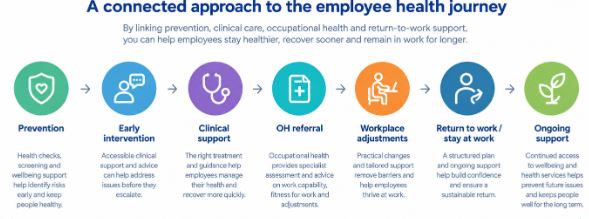
In REBA's Health and Wellbeing Research 2026, fewer than one in 10 employers say they currently utilise an integrated workforce health model. However, 70% plan to begin or further refine their health, wellbeing and prevention offerings into a single continuous process.
For employees, this means a simpler route to appropriate support. For HR teams, it means clearer processes and fewer unique services to coordinate. And for business leaders, it provides greater visibility of workforce health needs and the opportunity to address issues early on before they affect productivity.
5 questions business leaders should ask
Does your organisation’s health strategy look integrated from an employee's perspective or the benefits team's perspective? If you are one of the many employers considering an upgrade to your current workplace health approach, ask yourself the following:
- Is there a clear pathway for support after a risk is identified? This is the point where most employees fall through the gaps in care.
- Can employees move easily between services or are they expected to manage multiple providers themselves? The more difficult the process, the longer it takes for employee health needs to be addressed.
- Does your occupational health service connect seamlessly with clinical support? With an integrated approach, referrals can be done in days, and an employee flagged in an assessment in treatment the same week.
- How well supported are your managers? Limited knowledge of occupational health due to infrequent use, exacerbated by managing multiple disconnected systems, means managers are likely to need support to execute an effective return to work plan.
- Are you measuring what matters? While utilisation, ease of access, intervention and recovery are useful metrics, positive employee outcomes are the true measurement of your strategy’s success.
Is your organisation ready to take a more connected approach to workforce health? Contact Square Health to discuss your organisation's requirements and explore how our integrated healthcare, wellbeing and occupational health services could support your people and your business.
Supplied by REBA Associate Member, Square Health
Integrated workplace health, combining absence management, health and wellness and occupational health into one solution.