
Can your health benefits survive CFO scrutiny?

Reward and benefits leaders know already that health benefits are the cornerstones of a thriving workforce. But when purse strings are tight, and boards are under pressure to demonstrate a clear return on area of spend, how do you prove that health benefits really do fuel productivity and, ultimately, profitability?
The pressure to prove value is growing
Across sectors, organisations are operating under sustained cost pressure and heightened accountability. Business leaders are looking for efficiencies wherever they can find them. With employee health benefits representing a significant investment, that spend is coming under closer scrutiny.
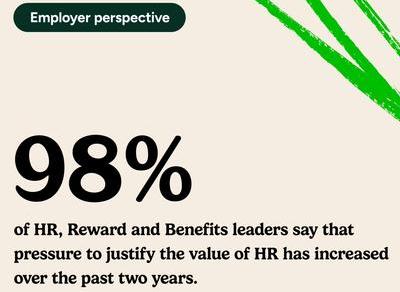
The scale of the shift is clear: Benifex’s research shows that 98% of HR, reward and benefits leaders say the pressure to justify HR’s value has increased over the past two years.
That pressure is unlikely to ease. In the same report, 65% say rising healthcare and benefits costs will become one of their organisation’s biggest financial pressures over the next two to three years.
It’s no longer enough to describe impact – leaders must prove it. That means demonstrating how reward and benefits strategies drive productivity and performance, evidencing return on investment in wellbeing, and showing how technology and AI improve both efficiency and outcomes at scale. In this context, credibility is shaped by evidence.
Leaders who can connect benefits and wellbeing data to business outcomes are far better positioned to secure sustained board level attention, investment, and trust – while those unable to do so risk seeing reward and benefits remain structurally undervalued, regardless of their potential impact.
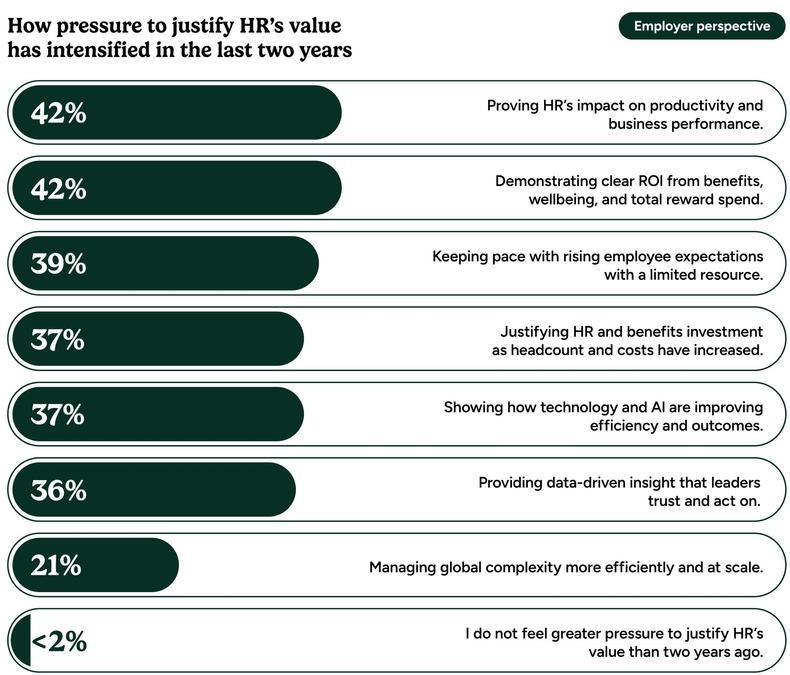
Translating people investment into business value
Benefits and wellbeing technology can materially improve outcomes at both the individual and organisational level by supporting employee health, engagement, and financial security, while enabling greater workforce resilience, productivity and performance.
However, over the past year, many organisations have delayed, reduced, or deprioritised HR technology spend due to cost control measures, competing strategic priorities, and difficulty demonstrating clear and consistent ROI.
This retrenchment is occurring alongside rising employee expectations. Employees continue to expect greater personalisation, accessibility, and relevance in their reward and benefits, increasing the delivery burden on HR teams at precisely the moment when resources are tightening.
Benifex’s research makes clear that HR, reward and benefits leaders understand what is required to unlock further investment. Boards and finance leaders are not seeking aspiration, but evidence. This means data that links benefits and HR technology spend to tangible outcomes such as productivity, operational efficiency, and improvements in top and bottom line performance.
It requires business cases that translate people data into financial models aligned with CFO priorities, and a clear demonstration that HR initiatives mitigate material risks, whether regulatory, financial, or reputational.
The survey of more than 600 HR and reward leaders highlights a recurring barrier:
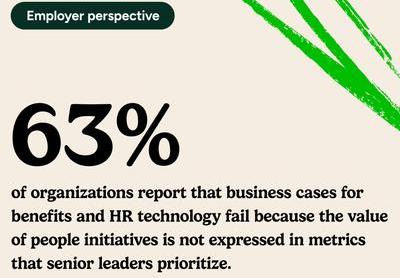
Simply put: the CHRO doesn’t speak the same language as the CFO, CEO, and board of directors. HR, reward and benefits teams frequently observe positive effects in real time: employees report better wellbeing, managers see improved efficiency, and cultural indicators suggest healthier ways of working. However, these signals are difficult to convert into evidence that aligns with executive priorities and criteria for decision making.
This measurement gap creates a disconnect: people can feel the impact but can’t prove it exists. Employees experience value, but organisations struggle to formally evidence it. As a result, benefits and wellbeing technology – despite its ability to generate rich, real time data – remains under leveraged as a strategic asset.
Breaking this cycle requires a shift in how value is defined, measured, and communicated. Organisations that succeed are those that explicitly connect people investment to workforce outcomes and, in turn, to business performance. This includes using benefits technology as part of the core HR data architecture, enabling more sophisticated analytics that link benefits engagement to productivity, efficiency, risk mitigation, and financial performance.
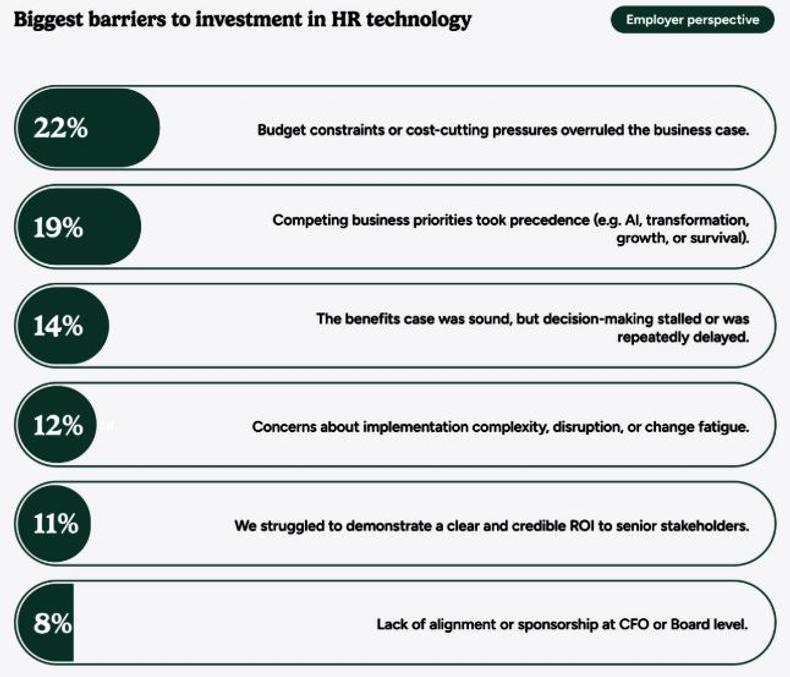
Ultimately, value is determined by the audience receiving it. Right now, boards are focused on productivity and growth, and profitability. Reward and benefits strategies that are framed – and evidenced – in those terms are far more likely to secure investment, influence decisions, and be recognised as essential infrastructure.
It’s worth noting that the research showed 13% of HR leaders did successfully progress HR technology investment in 2025 – a reminder that where the business case is made effectively, investment follows.
For HR, reward and benefits leaders, the ability to make this connection is becoming a defining capability for impact and credibility.
Download the Energizing Reward and Benefits report.
Supplied by REBA Associate Member, Benifex
The home of award-winning employee benefits, reward, recognition, & communications.