Why the timing of MSK prevention determines its ROI

Reward and benefit leaders often face a hard pitch to make to a finance director: invest now, wait years, hope the return shows up before the budget cycle turns over.
That reluctance has a real cost behind it. Aon forecasts that employer-sponsored medical plan costs will rise by an average of 9.8% globally in 2026, and names MSK and back issues among the leading drivers of UK medical plan costs.
Against that backdrop, a general promise that prevention pays off eventually is not enough. Employers need to know when, in a condition's trajectory, action is most likely to pay off.
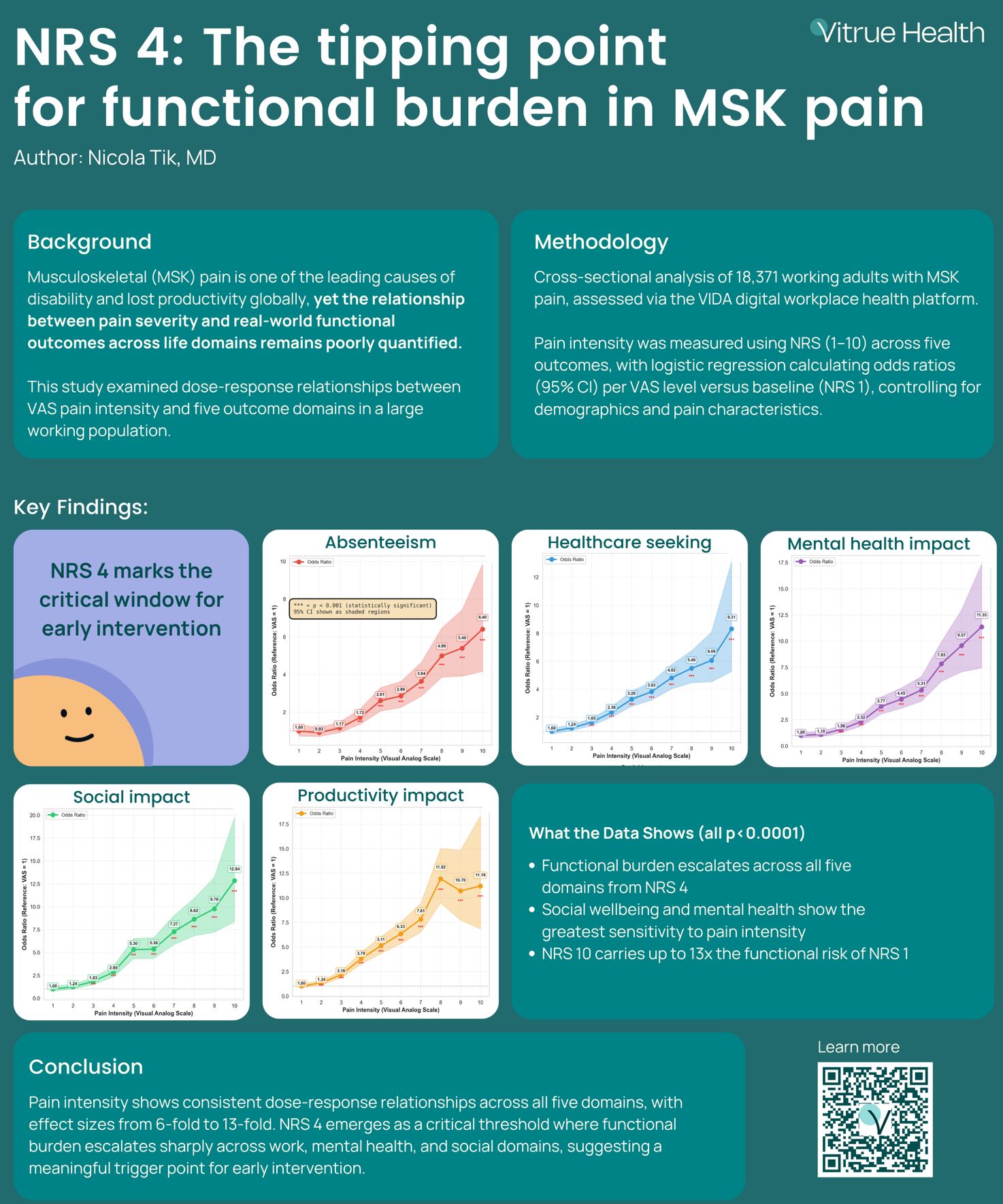
New analysis from a sample of 18,371 working adults with musculoskeletal (MSK) pain suggests the ROI question has been framed wrongly from the start. The long game of prevention is not about waiting years for a return. It is about not waiting for pain to escalate past a numerical rating scale (NRS) of 4, the point on the standard 1–10 pain intensity scale where functional burden begins to climb sharply.
Get the timing right, and the case for prevention stops being an act of faith and starts being an operational decision with a measurable trigger point.
What the data shows
We used the VIDA digital workplace health platform to run a cross-sectional analysis of pain intensity against five outcomes: absenteeism, healthcare seeking, mental health impact, social impact and productivity impact. Logistic regression returned odds ratios for each pain level against a baseline of NRS 1, controlling for demographics and pain characteristics. Every relationship reported here is statistically significant at p<0.0001.
The pattern across all five domains is consistent: functional burden does not rise gradually. It escalates sharply from NRS 4. Below that point, the odds of absence, healthcare-seeking, mental health impact, social withdrawal and reduced productivity stay comparatively flat. From NRS 4 onward, the curve steepens quickly, and by NRS 10 the odds of functional impact are six to thirteen times higher than at NRS 1, with social wellbeing and mental health showing the greatest sensitivity to rising pain.
Why this changes the ROI conversation
Most health strategies are still built around identifying pain, then treating it once it becomes disruptive enough to show up in absence records or PMI claims. By that point, the employee is often well past NRS 4. The cost of support at that stage is not proportionally higher than it would have been earlier; it is disproportionately higher, because the functional burden itself has scaled non-linearly.
That is the economic case for early intervention in a single number: NRS 4 is not just a clinical threshold, it is the point at which the cost of inaction starts to outpace the cost of support. Reaching employees before that point, rather than after, is what moves prevention from a long-term bet to a near-term, trackable lever on cost.
What this means for employers
For strategy and policy teams building the case for preventative investment, three practical shifts follow from this:
- Target the threshold, not the diagnosis. Workforce health data should flag pain intensity, not just presenteeism or absence, so that intervention can be triggered around NRS 4 rather than waiting for a claim or a return-to-work case.
- Build referral pathways for “moderate”, not just “severe”. Occupational health and MSK support pathways are often built for employees already in crisis. The data suggests the meaningful window opens earlier, while pain is still classed as moderate.
- Reframe the ROI timeline for finance stakeholders. The return on prevention is not necessarily years away. It is a function of how early in the pain trajectory the workforce is reached. Intervening at NRS 4 rather than NRS 7 or 8 is a different, and more favourable, ROI calculation, not simply a slower version of the same one.
The long game, reconsidered
None of this suggests prevention is a quick fix, and the figures here describe an association, not a guarantee of outcomes for any individual employee.
What the data does offer is a more precise way to think about timing: the long game is not about employers being patient with the return. It is about not being patient with pain once it crosses a threshold that, until now, has been difficult to pin down.
NRS 4 gives strategy and policy teams a concrete, evidence-led point to design around, and a stronger answer for the finance director asking when prevention starts to pay.
Supplied by REBA Associate Member, Vitrue Health
AI-powered MSK health - preventing pain before it hits claims and pathways