Are your employees' health needs really being addressed?

The youngest member of your team and the oldest can be more than 50 years apart in age. They walk into the same office, log into the same intranet, and access the same benefits portal, but they are living entirely different lives.
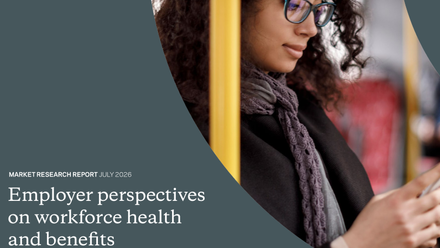
Mercer's Health on Demand 2025 report makes the gap visible: 48% of employees say benefits communications fail to engage them, and almost half of caregivers worry about meeting monthly bills.
A reward strategy that genuinely runs “from the youngest to the oldest” has to address a much wider set of pressures than most programmes do - and one of the biggest, caring responsibilities, spans the whole age range in ways many employers haven’t yet clocked.
The youngest: pressure, precarity and unexpected caring duties
At one end of the workforce sit Gen Z and younger millennials, often in their first or second job, often the most digitally native and the most outspoken about workplace expectations. The pressures they carry are rarely the ones HR plans for.
Deloitte's 2024 Gen Z and Millennial Survey found that 47% of UK Gen Zs feel anxious or stressed most of the time, and only around half rate their mental health as “good” or better.
They are entering work with record levels of student debt, into housing markets they cannot afford, and they expect their employer to do something about it. Their health needs are also broader than HR often assumes: fertility journeys starting earlier and lasting longer, chronic conditions managed since childhood, neurodivergence identified later in life, and at least 376,000 young adult carers aged 16 to 25 in the UK already supporting a parent or sibling alongside their job. A programme aimed only at the unencumbered version of a Gen Z employee misses people walking into work already exhausted.
The oldest: experience, seniority, and the sandwich years
At the other end sits a fast-growing population of over-50s. They are more likely to occupy senior roles, hold institutional knowledge, and shape culture. They are also navigating a phase of life that frequently coincides with caring responsibilities, for ageing parents, partners with long-term conditions, or grandchildren.
Carers UK puts the peak age for becoming a carer at 45 to 64, and reports that around 600 people leave employment in the UK every working day because they cannot reconcile the job with the caring responsibility. The DWP now estimates that unpaid carers being out of work costs the UK economy £37 billion a year.
This is the sandwich generation: employees caring for older relatives while still raising or financially supporting children, typically in their forties and fifties, often female, and often the most senior individuals on a team.
Their health needs look very different from Gen Z's: anticipatory grief, sleep disruption, musculoskeletal strain from physically supporting a relative, and the slow, grinding burnout of being the family decision-maker on top of being the team's. Yet they are far less likely to use a meditation app, a virtual GP, or a fertility benefit. The benefits they actually need - practical eldercare navigation, paid carer's leave, peer support - are still rare in mainstream programmes.
The thread that connects both ends
The youngest and the oldest in your workforce can look like two completely different problems. They are not. The pattern is the same at both ends: real, predictable health needs sitting outside the standard EAP-and-PMI playbook, served by benefits designed for someone in the middle.
Caring responsibilities are the clearest example. The 2021 Census recorded 5.8 million unpaid carers in the UK, ranging from young adults supporting a parent with a long-term condition to senior leaders running their department by day and a parent's care plan by night. But the same pattern shows up in mental health, fertility, menopause and financial wellbeing — visible at one end of the workforce, invisible at the other, and rarely joined up.
What “addressed” actually looks like
A benefits strategy that supports both ends of the workforce tends to do four things.
First, it segments by life stage, not just by job grade. The benefits an early-career joiner notices are not the ones a senior leader needs, and a single intranet page is not a strategy for either of them.
Second, it offers expert, human support. Whether the issue is fertility, menopause, mental health, or navigating social care for an ageing parent, employees consistently say the hardest part is finding their way through a fragmented system. Concierge-style support reduces the cognitive load that otherwise bleeds straight into the working day.
Third, it makes time the benefit. Flexible working as a default, phased returns, and paid leave that flexes around real-life events. Statutory carer's leave, now a legal floor, illustrates the point: 56% of working carers say they cannot afford to take it because it is unpaid. The same logic applies to fertility leave, menopause adjustments, and recovery from major illness.
Fourth, it equips line managers. Whether the employee is 24 or 54, and whether the issue is mental health, menopause, fertility or eldercare, they almost always tell their manager first. If managers do not know how to hold the conversation, the rest of the strategy collapses at the very first interaction.
The strategic ask
The phrase “from the youngest to the oldest” is easy to write into a strategy paper and harder to design for. It demands honesty about who your benefits programme actually serves today, and curiosity about who it does not.
The Gen Z hire and the senior leader stepping back to care for a parent are both at flight risk, for very different reasons. Designing a programme that holds both of them in mind is not a generosity exercise, it is how modern reward strategy retains experience at the top, talent at the bottom, and the human beings in between who hold most of the load.
Supplied by REBA Associate Member, KareHero
The #1 adult caregiving support service. Helping employees understand, find and fund their care journey. We protect over 1.2M families. Our benefit advisers have been helping families since 2016, and we have supported families in securing £16 million in care benefits and funding.